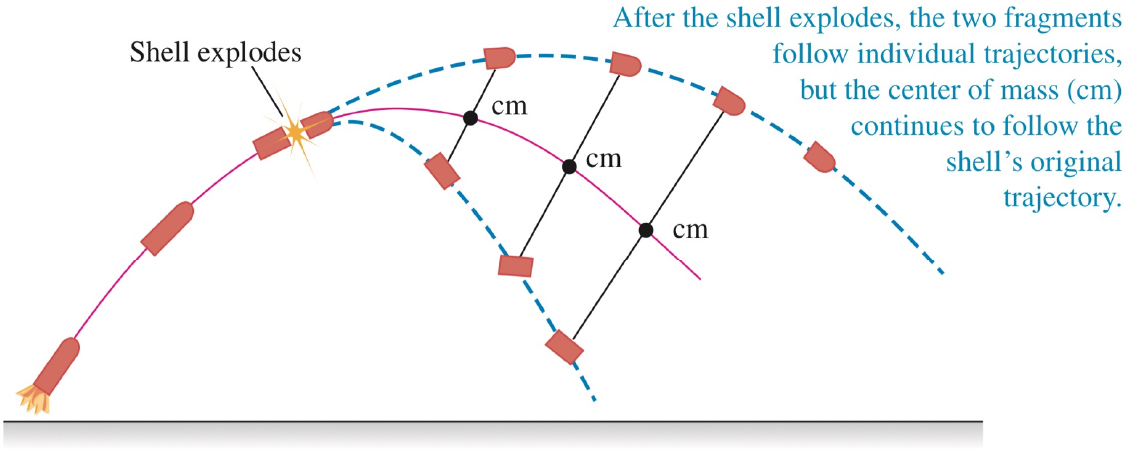
On this pageProjectile motion Horizontal motionvx=v0x=v0cosθx=(v0cosθ)t\begin{align*} v_x &= v_{0x} = v_0 \cos\theta \\ x &= (v_0 \cos\theta) t \end{align*}vxx=v0x=v0cosθ=(v0cosθ)tVertical motionvy=v0sinθ−gty=(v0sinθ)t−12gt2\begin{align*} v_y &= v_0 \sin\theta - gt \\ y &= (v_0 \sin\theta)t - \frac{1}{2}gt^2 \end{align*}vyy=v0sinθ−gt=(v0sinθ)t−21gt2 Parabolic trajectory of the projectile y=xtanθ−x2g2v02cos2θy = x\tan\theta - x^2\frac{g}{2v_0^2\cos^2\theta}y=xtanθ−x22v02cos2θg Time to reach max height:T=v0sinθgT = \frac{v_0\sin\theta}{g}T=gv0sinθTotal air time:t=2Tt = 2Tt=2TMaximum height:H=v02sin2θ2gH = \frac{v_0^2\sin^2\theta}{2g}H=2gv02sin2θHorizontal distance:D=vxt=2v02sinθcosθgD = v_xt = \frac{2v_0^2\sin\theta\cos\theta}{g}D=vxt=g2v02sinθcosθ Center of mass r⃗cm=∑imir⃗iMr⃗cm=xcmi^+ycmj^+zcmk^\begin{align*} \vec r_{cm} &= \frac{\sum\limits_i m_i \vec r_i}{M} \\ \vec r_{cm} &= x_{cm} \hat i + y_{cm} \hat j + z_{cm} \hat k \\ \end{align*}rcmrcm=Mi∑miri=xcmi^+ycmj^+zcmk^ rcmr_{cm}rcm: position vector of center of mass MMM: total mass of all point masses Center of gravityIf g⃗\vec gg is the same at all points on a body, CM = CG and a⃗cm=g⃗\vec a_{cm} = \vec gacm=g