Thermodynamics

Basic info (click to expand)

Number of moles n=mM=NNAn = \frac{m}{M} = \frac{N}{N_A}

  • MM: molar mass (kg/mol), mass of 1 mole of the substance
  • NN: number of molecules
  • NA=6.02×10²³N_A = 6.02\times10^{23} mol1^{-1} : Avogadro constant

Pressure =ForceArea= \frac{\text{Force}}{\text{Area}}

Density =MassVolume= \frac{\text{Mass}}{\text{Volume}}

Litter to cubic meter: 11L = 1×1031\times10^{-3} m3^3

Summary

First law of thermodynamics: ΔU=QinWby\Delta U = Q_{in} - W_{by}

Change in internal energyHeatWork done
U=f2nRTU = \frac{f}{2}nRTQin=nCΔTQ_{in} = nC\Delta TWby=V1V2pdVW_{by} = \int_{V_1}^{V_2} pdV
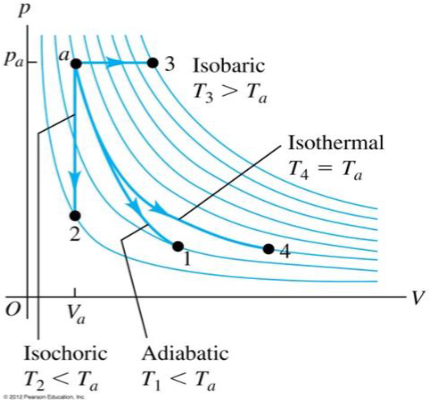
Isothermal (ΔT=0\Delta T = 0)ΔU=0\Delta U = 0Qin=WbyQ_{in} = W_{by}Wby=nRTln(V2V1)W_{by} = nRT\ln\left(\frac{V_2}{V_1}\right)
Isochoric (ΔV=0\Delta V = 0)ΔU=Qin=f2nRΔT\Delta U = Q_{in} = \frac{f}{2}nR\Delta TQin=nCVΔTQ_{in} = nC_V\Delta TWby=0W_{by} = 0
Isobaric (Δp=0\Delta p = 0)ΔU=f2pΔV=f2nRΔT\Delta U = \frac{f}{2}p\Delta V = \frac{f}{2}nR\Delta TQin=nCpΔTQ_{in} = nC_p\Delta TWby=pΔV=nRΔTW_{by} = p\Delta V = nR\Delta T
Adiabatic (Qin=0Q_{in} = 0)ΔU=Wby\Delta U = -W_{by}Qin=0Q_{in} = 0Wby=1γ1(p1V1p2V2)W_{by} = \frac{1}{\gamma-1}(p_1V_1 - p_2V_2)

Ideal gas law

pV=nRT=NkT\begin{align*} pV = nRT = NkT \end{align*}
  • R=8.314R = 8.314 J/mol\cdotK : universal gas constant
  • k=1.381×10²³k = 1.381\times10^{-23} J/K : Boltzmann constant

First law of thermodynamics

ΔU=QinWby\Delta U = Q_{in} - W_{by}
  • ΔU\Delta U: change in internal energy
  • path-independent
  • For a cyclic process, ΔU=0\Delta U = 0

  • QinQ_{in}: heat enters into system from surroundings
  • path-dependent

  • WbyW_{by}: work done by the system
  • = Area under p-V curve
  • path-dependent
  • Expansion: Wby>0W_{by} > 0
  • Compression: Wby<0W_{by} < 0
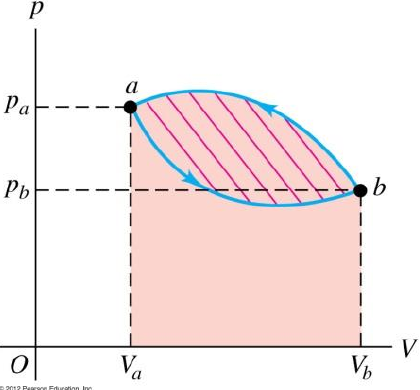
p-V diagramCyclic process

Example cyclic process with Wnet<0W_{net} < 0

KE of ideal gas

Total translational KE of all molecules:

Ktot=32nRT=32NkTK_{tot} = \frac{3}{2}nRT = \frac{3}{2}NkT

Root-mean-square speed of molecules:

vrms=3RTM=3kTmv_{rms} = \sqrt{\frac{3RT}{M}} = \sqrt{\frac{3kT}{m}}

Most probable speed of molecules:

vmp=2RTM=2kTmv_{mp} = \sqrt{\frac{2RT}{M}} = \sqrt{\frac{2kT}{m}}

Average speed of molecules:

vav=8RTπM=8kTπmv_{av} = \sqrt{\frac{8RT}{\pi M}} = \sqrt{\frac{8kT}{\pi m}}

Molar heat capacity of ideal gas

At constant volume:

CV=f2RC_V = \frac{f}{2}R

At constant pressure:

Cp=f+22RC_p = \frac{f+2}{2}R

Adiabatic index:

γ=CpCV=f+2f\gamma = \frac{C_p}{C_V} = \frac{f+2}{f}

Degrees of freedom ff

Monoatomic gas:

  • f=3f = 3 and γ=53\gamma = \frac{5}{3}
  • Translation only

Diatomic gas:

  • f=5f = 5 and γ=75\gamma = \frac{7}{5}
  • Translation + rotation
  • At very high temperature:
    • f=7f = 7 and γ=97\gamma = \frac{9}{7}
    • Translation + rotation + vibration

Adiabatic process

  • Q=0Q = 0 : no heat enters into or exits from the system
  • e.g. free expansion of gas
pVγ=constantTVγ1=constantWby=1γ1(p1V1p2V2)\begin{align*} pV^\gamma &= \text{constant} \\ TV^{\gamma-1} &= \text{constant} \\ W_{by} &= \frac{1}{\gamma-1}(p_1V_1 - p_2V_2) \end{align*}

Second law of thermodynamics

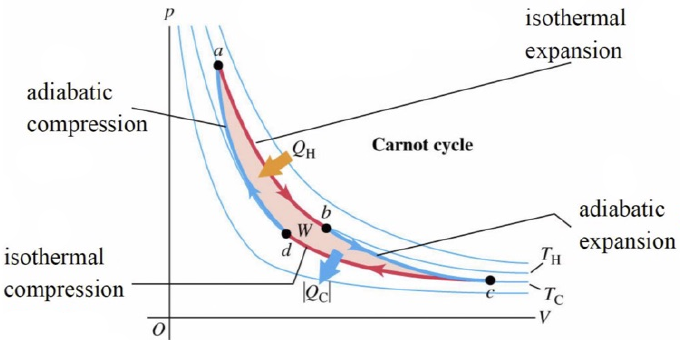
Carnot cycle

Carnot engine

Thermal efficiency:

e=WQH=1QCQHe1TCTH<1\begin{align*} e &= \frac{W}{|Q_H|} = 1 - \frac{|Q_C|}{|Q_H|} \\ e &\le 1 - \frac{T_C}{T_H} < 1 \end{align*}

where TCT_C and THT_H are in Kelvin

Refrigerator

Coefficient of performance:

K=QCW=QCQHQCKTCTHTC\begin{align*} K &= \frac{|Q_C|}{|W|} = \frac{|Q_C|}{|Q_H| - |Q_C|} \\ K &\le \frac{T_C}{T_H - T_C} \end{align*}

where TCT_C and THT_H are in Kelvin

Carnot cycle