Wave and sound

Transverse waves

  • Particle moves up and down, perpendicular to the motion of the wave
  • Crest: y=Ay = A and trough: y=Ay = -A
k=2πλv=fλ=ωkf=ω2πT=1f\begin{align*} k &= \frac{2\pi}{\lambda} \\ v &= f\lambda = \frac{\omega}{k} \\ f &= \frac{\omega}{2\pi} \\ T &= \frac{1}{f} \end{align*}
  • kk: wave number (m1^{-1})
info

Wave speed on a string: v=Tμv = \large\sqrt{\frac{T}{\mu}}

  • TT: equilibrium tension of the string
  • μ\mu: mass per unit length of the string
Challenging question

A uniform rope of mass mm and length LL hangs vertically from a ceiling. The time tt it takes for a transverse wave to travel the length of the rope is:

T=μgy and μ=mLt=yv=0Ldyv=0Lμμgydy=1g0Ldyy=2Lg\begin{align*} T = \mu gy &\text{ and } \mu = \frac{m}{L} \\ t = \frac{y}{v} &= \int_0^L \frac{dy}{v} \\ &= \int_0^L \sqrt{\frac{\mu}{\mu gy}} dy \\ &= \frac{1}{\sqrt{g}} \int_0^L \frac{dy}{\sqrt{y}} \\ &= 2\sqrt{\frac{L}{g}} \end{align*}

Wave equation for transverse waves

Wave traveling +ve x-direction:

y(x,t)=Acos(kxωt)y(x,t) = A\cos(kx-\omega t)

Wave traveling −ve x-direction:

y(x,t)=Acos(kx+ωt)y(x,t) = A\cos(kx+\omega t)
Superposition

If y1y_1 and y2y_2 are incoming wave and reflected wave, their resultant wave y=y1+y2y = y_1 + y_2

vy(x,t)=ωAsin(kxωt)vmax=ωAay(x,t)=ω2Acos(kxωt)amax=ω2A\begin{align*} v_y(x,t) &= \omega A\sin(kx-\omega t) \\ v_{max} &= \omega A \\ a_y(x,t) &= -\omega^2 A\cos(kx-\omega t) \\ a_{max} &= \omega^2 A \end{align*}
warning

vyv_y is the speed of a particle, not the wave speed.

Energy in wave motion

  • PP: power of the wave
  • II: intensity of the wave (W/m2^2)
P(x,t)=μTω2A2sin2(kxωt)Pmax=μTω2A2Pav=12PmaxI=P4πr2\begin{align*} P(x,t) &= \sqrt{\mu T}\omega^2A^2sin^2(kx-\omega t) \\ P_{max} &= \sqrt{\mu T}\omega^2A^2 \\ P_{av} &= \frac{1}{2}P_{max} \\ I &= \frac{P}{4\pi r^2} \end{align*}

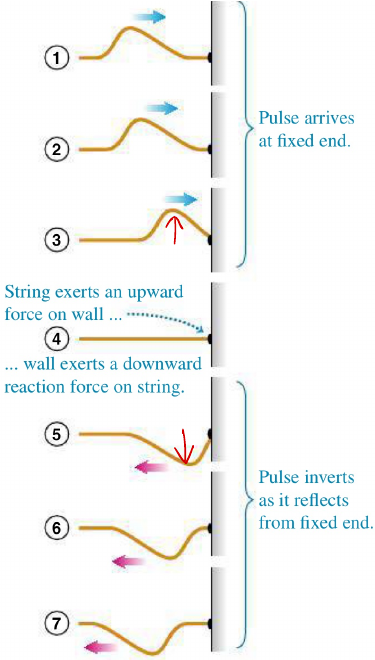
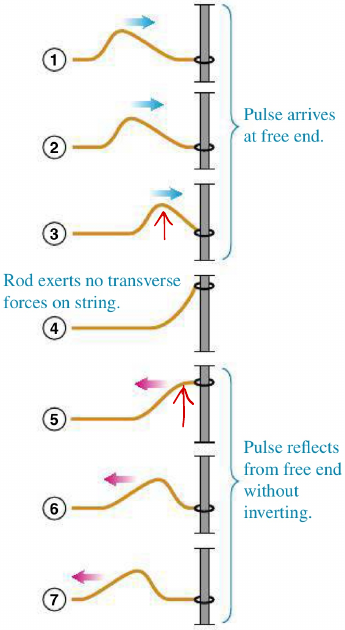
Reflection of transverse waves

Fixed boundaryOpen boundary

Standing waves

  • Node: zero amplitude, destructive interference
  • Antinode: maximum amplitude, constructive interference

Standing waves for fixed boundary condition

y(x,t)=2Asin(kx)sin(ωt)\begin{align*} y(x,t) &= 2A\sin(kx)\sin(\omega t) \end{align*}
  • Nodes at x=0,λ2,λ,3λ2,...x = 0,\large\frac{\lambda}{2}\normalsize,\lambda,\large\frac{3\lambda}{2}\normalsize,...
  • Antinodes at x=λ4,3λ4,5λ4,...x = \large\frac{\lambda}{4}\normalsize,\large\frac{3\lambda}{4}\normalsize,\large\frac{5\lambda}{4}\normalsize,...

Standing waves for open boundary condition

y(x,t)=2Acos(kx)cos(ωt)\begin{align*} y(x,t) &= 2A\cos(kx)\cos(\omega t) \end{align*}
  • Nodes at x=λ4,3λ4,5λ4,...x = \large\frac{\lambda}{4}\normalsize,\large\frac{3\lambda}{4}\normalsize,\large\frac{5\lambda}{4}\normalsize,...
  • Antinodes at x=0,λ2,λ,3λ2,...x = 0,\large\frac{\lambda}{2}\normalsize,\lambda,\large\frac{3\lambda}{2}\normalsize,...

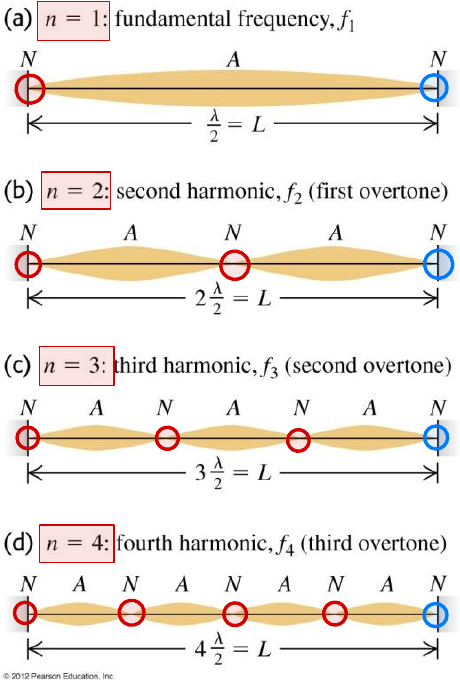
Harmonics

Fundamental frequency (n=1n = 1):

f1=v2Lf_1 = \frac{v}{2L}

Second harmonic (n=2n = 2):

f2=2f1f_2 = 2f_1

n-th harmonic:

fn=nf1f_n = nf_1
  • Length of the string L=nλ2L = \frac{n\lambda}{2}
Harmonics

Sound waves

Beats

Superposition of two sound waves
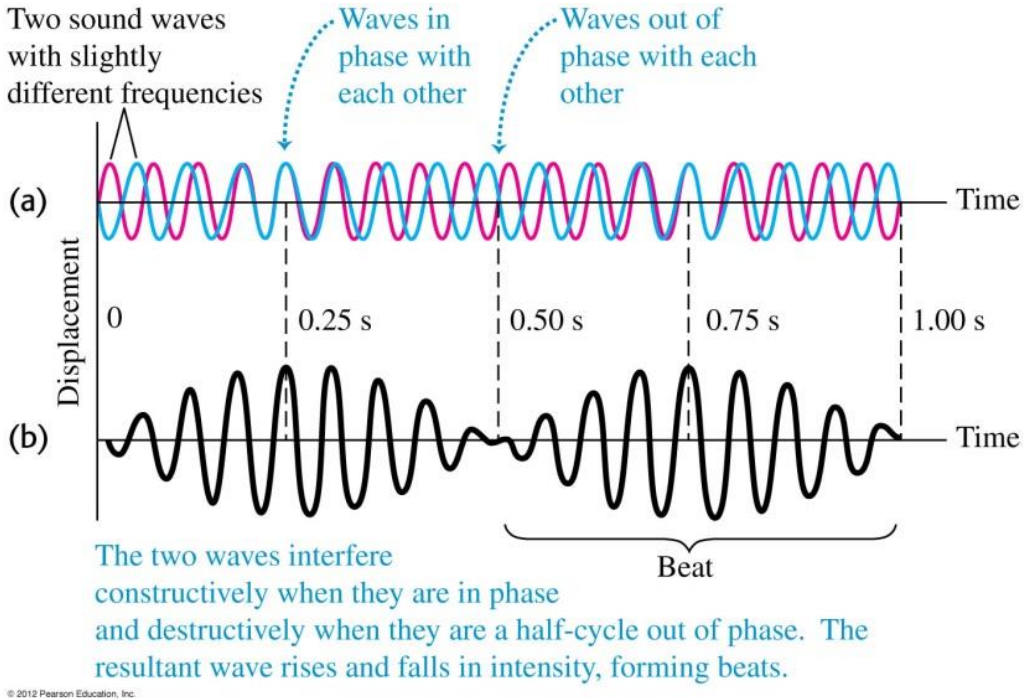
fbeat=f1f2Tbeat=1f1f2\begin{align*} f_{beat} &= |f_1-f_2| \\ T_{beat} &= \frac{1}{|f_1-f_2|} \end{align*}
Beats

Doppler effect of sound

fL=(v+vLv+vS)fS\begin{align*} f_L = \left(\frac{v+v_L}{v+v_S}\right)f_S \end{align*}
  • fLf_L: frequency at the listener
  • fSf_S: frequency of the source
  • vLv_L: velocity of the listener
  • vSv_S: velocity of the source
warning

For vLv_L and vSv_S: direction pointing from listener to source is positive

e.g. If the listener is approaching the source, while the source is approaching the listener:

vL>0 and vS<0fL>fSv_L > 0 \text{ and } v_S < 0 \Rightarrow f_L > f_S

Doppler effect of light (out of syllabus?)
fR=cvc+vfS\begin{align*} f_R = \sqrt{\frac{c-v}{c+v}}f_S \end{align*}

where vv is the relative velocity between the receiver and the source