Circular motion

Uniform circular motion

Radial acceleration:

arad=v2ra_{rad} = \frac{v^2}{r}

Period:

T=2πrv=2πraradT = \frac{2\pi r}{v} = 2\pi\sqrt{\frac{r}{a_{rad}}}

Object inside rotating cylinder

n=mv2rmgv>rgif n>0\begin{align*} n &= \frac{mv^2}{r} - mg && \\ v &\gt \sqrt{rg} && \text{if } n \gt 0 \end{align*}
  • nn: normal force (at the top of the cylinder) acting on the object
  • if n0n \le 0 (i.e. vrgv \le \sqrt{rg}) then the object loses contact with the surface

Conical pendulum

arad=gtanθT=2πLcosθg\begin{align*} a_{rad} &= g\tan\theta \\ T &= 2\pi\sqrt{\frac{L\cos\theta}{g}} \end{align*}
Conical pendulum

Car rounding curve without skidding

Flat curve

mv2r=μsmgvmax=μsgr\begin{align*} \frac{mv^2}{r} &= \mu_s mg \\ \therefore v_{max} &= \sqrt{\mu_s gr} \end{align*}

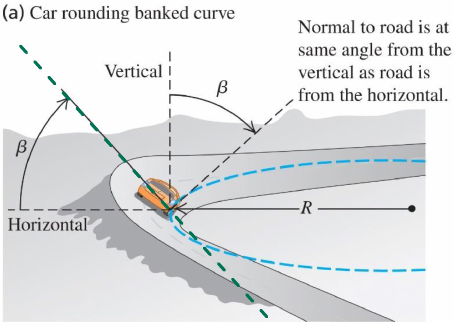
Banked curve

Fx=mv2r=nsinθ+μsncosθ(1)Fy=0=ncosθμsnsinθmg(2)vmax=grtanθ+μs1μstanθ(vflat)max\begin{align*} \sum F_x &= \frac{mv^2}{r} = n\sin\theta + \mu_s n\cos\theta && (1) \\ \sum F_y &= 0 = n\cos\theta - \mu_s n\sin\theta - mg && (2) \\ \therefore v_{max} &= \sqrt{gr\frac{\tan\theta + \mu_s}{1 - \mu_s \tan\theta}} \\ &\ge (v_{flat})_{max} \end{align*}
Car rounding banked curve