Moment of inertia

Basic info (click to expand)
  • s=rθs = r\theta , ω=dθdt\omega = \frac{d\theta}{dt} , α=dωdt\alpha = \frac{d\omega}{dt}
  • Anticlockwise rotation: Δθ>0\Delta\theta > 0
  • Direction of ω\vec\omega is defined by the right-hand thumb rule
vtan=rωatan=rαarad=v2r=ω2r\begin{align*} v_{tan} &= r\omega \\ a_{tan} &= r\alpha \\ a_{rad} &= \frac{v^2}{r} = \omega^2 r \end{align*}

SI unit: kg\cdotm2^2

I=imiri2=r2dm=r2ρdrKrot=12Iω2\begin{align*} I &= \sum\limits_i m_i r_i^2 = \int r^2dm = \int r^2\rho dr \\ K_{rot} &= \frac{1}{2}I\omega^2 \end{align*}
  • ρ=ML\rho = \frac{M}{L} (density of the rod)

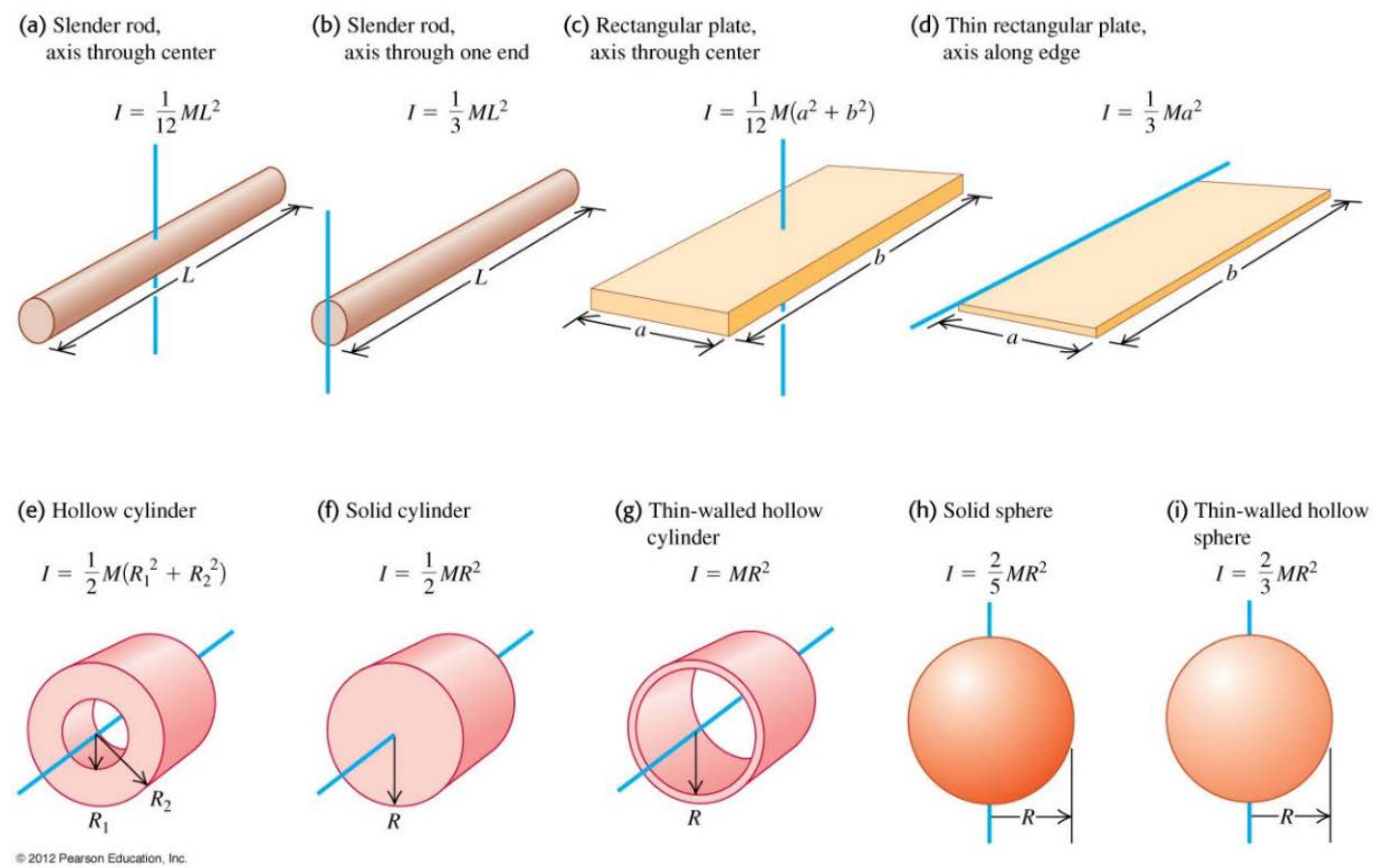
Moments of inertia of various bodies

Moments of inertia of various bodies

Parallel axis theorem

  • IpI_p: II about an axis parallel to the axis through its center of mass
  • IcmI_{cm}: II about an axis through its center of mass
  • MM: total mass of the rigid body
  • dd: perpendicular distance between the two axises
Ip=Icm+Md2\begin{align*} I_p &= I_{cm} + Md^2 \end{align*}

Torque

SI unit: N\cdotm

τ=dLdt=r×Fτ=rFsinθ=IαW=τdθP=τω\begin{align*} \vec\tau &= \frac{d\vec L}{dt} = \vec r \times\vec F \\ \tau &= rF\sin\theta \\ &= I\alpha \\ W &= \int \tau d\theta \\ P &= \tau\omega \end{align*}
  • θ\theta: angle (anticlockwise) from the radial arm to the line of action
  • Direction of τ\vec\tau is defined by the right-hand thumb rule

Rolling up/down without slipping

  • vcm=rω\vec v_{cm} = r\omega
  • Contact point must be at rest: v=0\vec v = 0
  • There must be static friction which is always up the slope, but it does no work